When planning outdoor projects, one key question always arises: How long will stainless steel screws last? Understanding Stainless Fastener Lifespan is essential for ensuring structural safety, durability, and long-term cost efficiency. While stainless steel is known for its corrosion resistance, actual performance depends on environment, material grade, and installation quality.
This guide provides a clear, practical breakdown of outdoor fastener durability, helping you maximize fastener life expectancy and avoid premature stainless steel bolt failure.
What Determines Stainless Fastener Lifespan?
Stainless steel resists corrosion through a protective chromium oxide “passive layer.” However, this protection is not absolute. The lifespan of stainless fasteners varies significantly based on the following factors:
1. Environmental Conditions (Primary Factor)
The operating environment has the greatest impact on Stainless Fastener Lifespan:
- Rural/Inland Areas: Low pollutants → longest lifespan.
- Urban Environments: Moderate exposure to pollution.
- Coastal/Marine Areas: High chloride exposure → increased corrosion risk.
- Industrial Zones: Chemicals and emissions accelerate degradation.
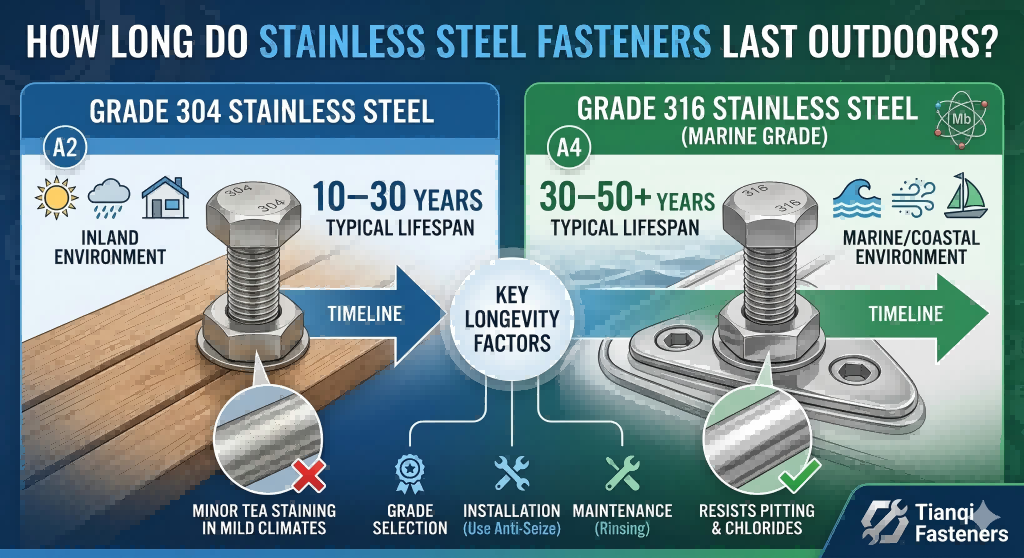
In coastal environments, lower-grade fasteners may show corrosion (tea staining or pitting) within months if improperly selected.
2. Stainless Steel Grade
Material selection directly affects fastener life expectancy:
- 304 Stainless Steel: Suitable for general outdoor use → lifespan of 10–30 years.
- 316 Stainless Steel (Marine Grade): Enhanced chloride resistance → 30–50+ years in harsh environments.
- Duplex Stainless Steel (e.g., 2205 / 2507): Superior strength and corrosion resistance → longest lifespan in extreme conditions.
Using the correct grade is the most effective way to prevent stainless steel bolt failure.
3. Installation and Design
Even high-quality fasteners can fail prematurely if installed incorrectly:
- Over-tightening damages the protective layer.
- Poor drainage traps moisture, causing crevice corrosion.
- Mixing dissimilar metals leads to galvanic corrosion.
Proper installation significantly improves outdoor fastener durability.
4. Moisture and Chloride Exposure
Chlorides (salt) are the primary cause of stainless corrosion:
- Saltwater accelerates pitting corrosion.
- High humidity increases risk.
- Standing water promotes localized corrosion.
Designing for drainage and ventilation is critical in outdoor applications.
How Long Will Stainless Steel Screws Last?
Here are typical lifespan ranges:
- Indoor or sheltered outdoor: 20–50+ years.
- General outdoor environments: 10–30 years.
- Coastal or harsh environments: 5–25 years (depending on grade).
These estimates highlight the importance of material selection and proper use.
Common Causes of Stainless Steel Bolt Failure
Despite their durability, fasteners can fail due to specific mechanisms:
- Pitting & Crevice Corrosion: Localized damage caused by trapped moisture and chlorides.
- Galvanic Corrosion: Occurs when stainless steel contacts dissimilar metals (e.g., aluminum) in wet conditions.
- Stress Corrosion Cracking (SCC): Caused by high stress and aggressive environments, sometimes linked to incorrect torque.
Recognizing these risks helps extend Stainless Fastener Lifespan.
Signs of Fastener Failure
Early detection prevents costly structural issues. Watch for:
- Rust spots or discoloration.
- Surface pitting or “craters”.
- Thread wear or deformation.
- Loosening under load.
- Cracks or visible deformation
These are clear indicators of declining fastener life expectancy.
When to Replace Fasteners?
A critical maintenance question is: When to replace fasteners?
Replace immediately if you observe:
- Deep pitting or corrosion.
- Persistent rust bleeding.
- Damaged or worn threads.
- Loss of torque or clamping force.
- Any structural deformation or cracking.
Routine inspection is essential for safety-critical applications.
Importance of Stainless Steel Fasteners Standards
Compliance with Stainless Steel Fasteners Standards ensures consistent quality and performance.
Key standards include: DIN / ISO / ANSI/ASME / JIS.
Certified fasteners provide verified strength, corrosion resistance, and longer service life.
How to Extend Stainless Fastener Lifespan
To maximize outdoor fastener durability, follow these best practices:
- Choose the correct grade (316 or duplex for harsh environments).
- Apply passivation to enhance corrosion resistance.
- Use anti-seize lubricants to prevent galling.
- Avoid mixing dissimilar metals.
- Ensure proper drainage and ventilation.
- Perform regular cleaning (especially in coastal areas).
- Conduct routine inspections.
These measures significantly improve long-term performance.
Conclusion
The Stainless Fastener Lifespan outdoors can range from 10 to over 50 years, depending on environmental conditions, material grade, and installation quality. While stainless steel offers excellent corrosion resistance, it is not maintenance-free. Proper selection, correct installation, and ongoing inspection are essential to prevent stainless steel bolt failure and ensure long-term reliability.
By following best practices and using certified fasteners, you can achieve maximum durability and safety in any outdoor application.