Stainless steel fasteners are widely used across construction, marine, industrial, and engineering applications because of their durability and corrosion resistance. However, one question frequently causes confusion: Are stainless steel fasteners magnetic or non-magnetic?
The answer depends on the stainless steel grade, metallurgical structure, and manufacturing process. Understanding the differences between Magnetic Stainless Steel Fasteners and Non-Magnetic Stainless Steel Fasteners is essential for selecting the correct material for marine, food-grade, electronic, and structural applications.
This guide explains why some stainless steel fasteners attract magnets, how magnetism impacts corrosion resistance, and when to choose magnetic or non-magnetic grades.
Why Are Some Stainless Steel Fasteners Magnetic?
Stainless steel is categorized into different metallurgical families based on its crystalline structure, which determines magnetic behavior.
Main Stainless Steel Families
- Austenitic stainless steel
- Ferritic stainless steel
- Martensitic stainless steel
- Duplex stainless steel
Austenitic Stainless Steel (300 Series)
Grades such as 304 and 316 are generally non-magnetic in their annealed state due to their austenitic structure.
Ferritic and Martensitic Stainless Steel (400 Series)
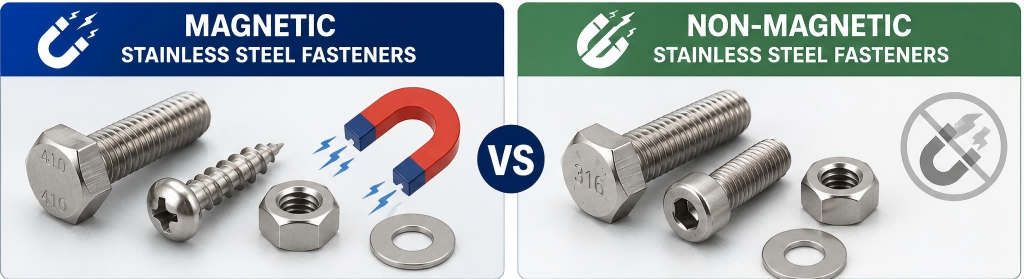
Grades such as 410 and 430 are naturally magnetic because of their high iron content and crystal structure. Many Magnetic Stainless Steel screws are produced from Grade 410 when higher hardness and strength are required.
What Are Magnetic Stainless Steel Fasteners?
Magnetic Stainless Steel Fasteners are typically manufactured from ferritic or martensitic stainless steels with lower nickel content.
Common Magnetic Grades
- 410 stainless steel
- 430 stainless steel
- Certain duplex stainless steels
These fasteners are strongly attracted to magnets because of their metallurgical structure.
Characteristics of Magnetic Stainless Fasteners
- High mechanical strength
- Good wear resistance
- Moderate corrosion resistance
- Lower cost than austenitic grades
- Suitable for specialized industrial applications
Common Applications
- Structural assemblies
- Automotive components
- Industrial machinery
- Heavy-duty fastening systems
What Are Non-Magnetic Stainless Steel Fasteners?
Non-Magnetic Stainless Steel Fasteners are usually made from austenitic stainless steel grades with higher nickel content.
Common Non-Magnetic Grades
- 304 stainless steel
- 316 stainless steel
These grades are naturally non-magnetic in their annealed condition.
Features of Non Magnetic Stainless Fasteners
- Excellent corrosion resistance
- High resistance to moisture and chemicals
- Superior marine performance
- Smooth hygienic surface finish
- Suitable for food-grade and medical applications
Common Applications
- Marine hardware
- Solar energy systems
- Food processing equipment
- Pharmaceutical machinery
- Electronics and medical devices
Are 304 and 316 Stainless Steel Magnetic?
One of the most searched questions is whether 304 and 316 stainless steel magnetic properties exist.
304 Stainless Steel
304 stainless steel is generally non-magnetic when fully annealed. However, cold working during manufacturing can alter its structure and create slight magnetism.
Examples include:
- Formed screws
- Cold-headed bolts
- Threaded fasteners
Slight magnetic attraction in 304 fasteners does not indicate poor quality.
316 Stainless Steel
316 stainless steel typically exhibits even lower magnetic response because of its higher nickel and molybdenum content.
In most cases:
- Annealed 316 is non-magnetic
- Cold-worked 316 may show weak magnetism
316 remains the preferred material for marine and highly corrosive environments.
Does Magnetic Stainless Steel Rust?
A common misconception is that magnetism directly causes corrosion. In reality, magnetic stainless steel rust resistance depends on alloy composition—not magnetism itself.
Corrosion Resistance Comparison
- 410 magnetic fasteners: Lower chromium and no nickel, making them more susceptible to corrosion than 304 or 316.
- 304/316 magnetic fasteners: Even when slightly magnetic after cold working, they retain high corrosion resistance because the chemical composition remains unchanged.
To maximize durability, passivation is recommended to restore and strengthen the protective oxide layer on stainless steel fasteners.
Key Differences Between Magnetic and Non-Magnetic Stainless Steel Fasteners
| Feature | Magnetic Stainless Steel Fasteners | Non-Magnetic Stainless Steel Fasteners |
|---|---|---|
| Common Grades | 410, 430 | 304, 316 |
| Magnetism | Strong | Weak or none |
| Corrosion Resistance | Moderate | Excellent |
| Strength | High | Moderate to high |
| Marine Suitability | Limited | Excellent |
| Cost | Lower | Higher |
| Typical Applications | Industrial, structural | Marine, food-grade, medical |
When to Specify Non-Magnetic Stainless Steel Fasteners
In sensitive technical applications, even slight magnetism can lead to system failures. Non-magnetic options (typically Grade 316) are required for:
- Medical Imaging Equipment: MRI systems require non-magnetic hardware to avoid interference with magnetic fields.
- Electronics and Sensors: Non Magnetic Stainless Steel screws prevent disruption to sensitive electronic systems and signal processing.
- Navigation Systems: Aviation and marine navigation equipment require minimal magnetic interference for accurate readings.
- Automated Assembly: Using Non Magnetic Bolts and specialized washers prevents parts from sticking together due to magnetic properties.
How to Choose the Right Stainless Steel Fastener
Selecting between these materials depends on your specific environment and strength requirements.
- Choose Magnetic Fasteners When: You require high strength, wear resistance, or cost efficiency in moderate environments.
- Choose Non-Magnetic Fasteners When: Corrosion resistance is critical, the environment is chemical-heavy, or you must avoid magnetic interference.
By evaluating your project’s environmental exposure and magnetic sensitivity, you can confidently select the hardware that ensures long-term reliability.
Conclusion
Understanding the difference between Magnetic Stainless Steel Fasteners and Non-Magnetic Stainless Steel Fasteners is essential for selecting the correct material for engineering and industrial applications.
Magnetic grades such as 410 provide higher strength and lower cost, while non-magnetic grades like 304 and 316 offer superior corrosion resistance for marine, hygienic, and outdoor environments. By evaluating environmental exposure, mechanical requirements, and magnetic sensitivity, engineers and buyers can confidently choose the right stainless steel fastener solution for long-term reliability and performance.