Encountering a fastener that refuses to budge is a common and frustrating challenge in maintenance and repair. While stainless steel is prized for being corrosion-resistant, it is also uniquely prone to galling and seizing—particularly when installed in aluminum or subjected to high friction. Learning how to Remove Seized Stainless Screws is a vital skill for anyone working with industrial or marine hardware to avoid halting repairs or damaging expensive components.
Whether you are dealing with stripped stainless fasteners or a stainless steel screw stuck in aluminum, this guide provides a logical, step-by-step approach to extraction without damaging the surrounding material.
Why Do Stainless Screws Seize?
Understanding why a fastener has seized helps you choose the most effective removal method. Seizure typically occurs due to:
- Galling: This occurs when the protective oxide layer shears off during installation friction, causing the metal threads to “cold weld” together.
- Galvanic Corrosion: A frequent issue when a stainless steel screw is stuck in aluminum, as these dissimilar metals react in the presence of moisture.
- Debris: Dirt or grit trapped within the fine threads can cause binding.
- Dissimilar Metals: Increases friction and binding.
- Over-tightening: This damages the threads and increases friction, often leading to seized or stripped stainless fasteners.
Step-by-Step Guide: How to Remove Seized Stainless Screws
Step 1: Penetrating Lubricants and Vibration
The first line of defense is chemical assistance.
- Apply Penetrating Oil: Spray a high-quality lubricant designed to “creep” into tight thread tolerances onto the screw and surrounding area.
- Add Vibration: Lightly tap the head of the screw with a hammer to create micro-vibrations, which help the lubricant penetrate deeper into the seized threads.
- Wait: Give the chemicals 15–30 minutes to break down corrosion and reduce friction.
This helps break down corrosion and reduce friction, making it easier to remove seized stainless screws.
Step 2: Try Manual Loosening
Before moving to power tools, try a controlled manual approach:
- Use the correct screwdriver or bit and apply firm, steady pressure.
- Slightly tighten first, then loosen to break the bond.
This step minimizes the risk of creating stripped stainless fasteners.
Step 3: Use an Impact Driver
For stubborn fasteners, an impact driver is highly effective. This tool delivers a controlled shock force that helps break through corrosion or galling without the risks associated with excessive constant torque. This is often the best method for how to remove seized set screws or extremely tight fasteners.
Step 4: Heat and Thermal Expansion
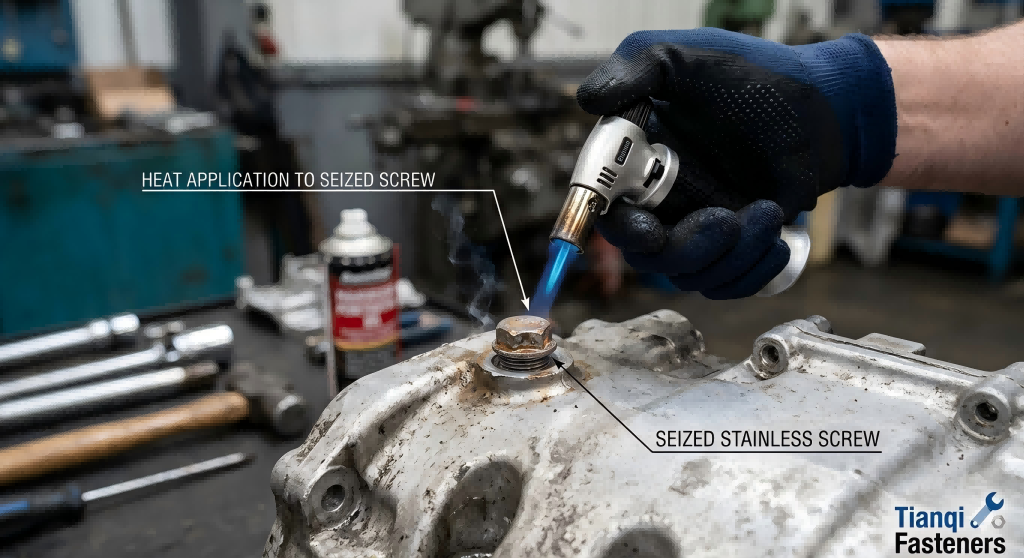
If chemicals and impact fail, heat is often the most effective way to remove seized stainless Steel bolts.
- The Physics: Heat causes the surrounding metal to expand at a different rate than the screw, breaking the bond of corrosion or thread-locking compounds.
- The Process: Use a propane or butane torch to heat the surrounding material, focusing on the metal around the screw rather than just the fastener itself. Allow slight cooling before attempting removal.
- Caution: Avoid heating the stainless steel until it is “glowing red,” as this can alter the metal’s temper and reduce its corrosion resistance.
This method is especially effective for a stainless steel screw stuck in aluminum.
Handling Stripped and Broken Fasteners
If the drive head is rounded out or the fastener snaps, follow these specialized extraction techniques:
- How to remove stripped stainless steel screws: If the head is accessible, use locking pliers to firmly grip the screw head and turn slowly. For recessed heads, use a manual impact driver to convert a hammer strike into high-torque rotational force—this is particularly useful for how to remove seized set screws.
- How to remove a broken stainless steel bolt: If the head snaps off, use a center punch to mark the exact center of the broken stud. Use a left-hand cobalt drill bit; often, the friction and reverse rotation will catch the bolt and spin it out during drilling.
- Screw Extractors: Drill a small pilot hole into the center and use a left-hand (reverse) extractor bit to pull the fastener out.
- Re-tapping: If the threads are destroyed during extraction, you may need to drill out the core entirely and use a thread repair kit, such as a Heli-Coil.
Special Case: Stainless Steel Screw Stuck in Aluminum
Removing a stainless steel screw stuck in aluminum requires extreme care because aluminum is softer and dissipates heat quickly. Galvanic corrosion between these metals makes seizing much more likely.
- The Approach: Use a 50/50 mix of Acetone and Automatic Transmission Fluid (ATF) as a DIY penetrating oil; it is highly effective against galvanic bonds.
- Avoid Excessive Force: Too much torque will strip the soft aluminum threads before the stainless screw moves.
How to Prevent Seizing in the Future
The best way to manage seized hardware is to prevent it during installation:
- Use Anti-Seize: Always apply a nickel-based anti-seize compound to the threads.
- Control Torque: Follow established stainless steel fastener torque guidelines.
- Isolate Metals: Use nylon washers or Tef-Gel when joining stainless steel to aluminum to block galvanic reactions.
- Maintain Hardware: Keep threads clean and free of debris. Protect fasteners from moisture and contaminants to extend their life.
These steps significantly reduce the risk of seizure and extend fastener life.
Common Mistakes to Avoid
- Using excessive force too early.
- Skipping lubrication.
- Using incorrect tools or drilling off-center.
- Overheating sensitive materials.
Conclusion
Knowing how to Remove Seized Stainless Screws requires the right tools, proper technique, and patience. Whether you are dealing with galling, corrosion, or stripped stainless fasteners, following a step-by-step approach ensures safe and effective removal. By applying these preventive practices and the correct extraction methods, you can handle even the most stubborn fasteners with confidence and minimize damage to your components.
Contact Tianqi Fasteners today for professional-grade hardware and expert technical advice on preventing fastener failure in your next project.